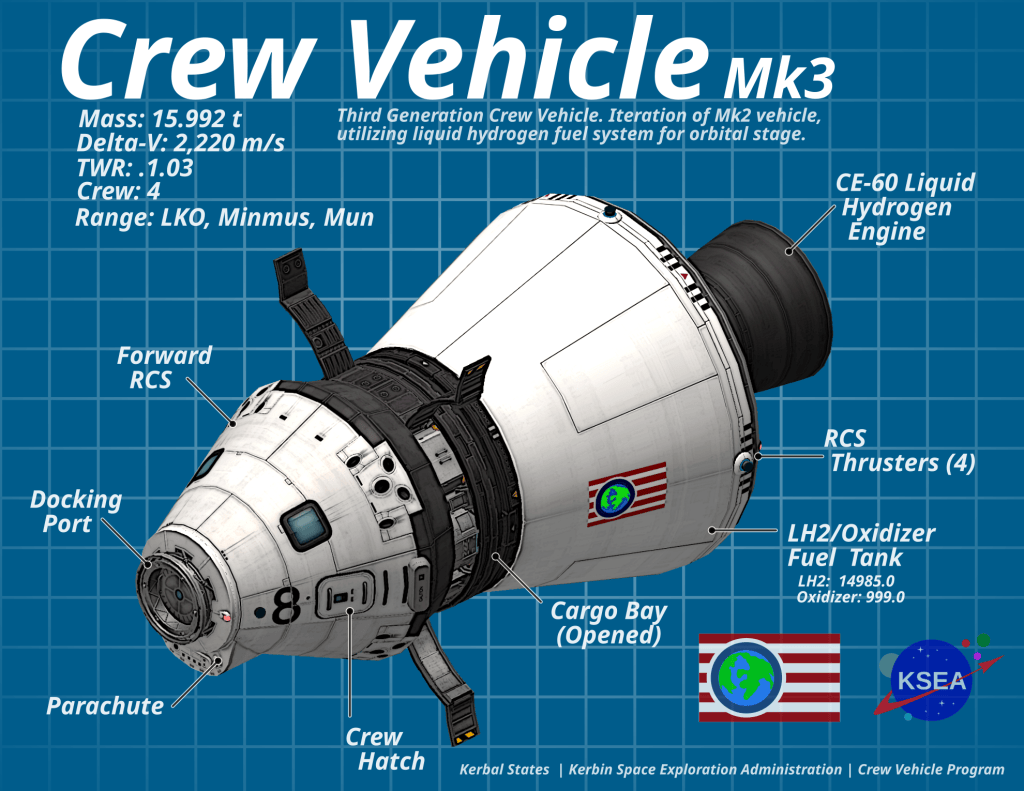
With the construction of the latest Crew Vehicle 8 (CV-8) KSEA engineers took the opportunity to overhaul and refine the spacecraft!
With the Mk3 Crew Vehicle KSEA is retiring the “Nebula” name to avoid confusion with other similarly named systems. Going forward the craft will simply be called a “Crew Vehicle” with differentiations indicated with the “mark” number!
“We have some missions coming up that are simply going to need more range – we think the mk3 Crew Vehicle is going to provide that!” -Gene, speaking at the Space Center
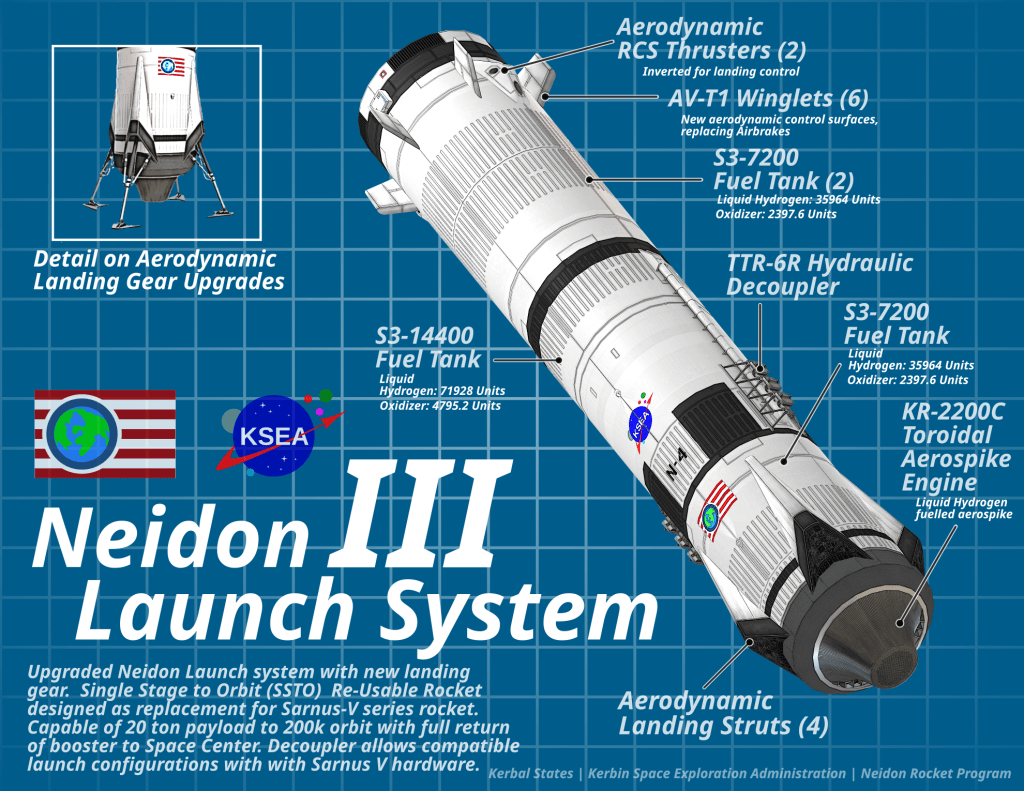
Work is nearly done upgrading the newly recovered N-4 Booster. It will be the test bed for the next iteration of Neidon rockets, Neidon III! This upgrade will make use of new landing gear that provides heat shielding in addition to better aerodynamics, both during landing and take off.
The rocket has also had a new paint job, rotating the logos and markings which engineers say make the rocket “42% cooler!”
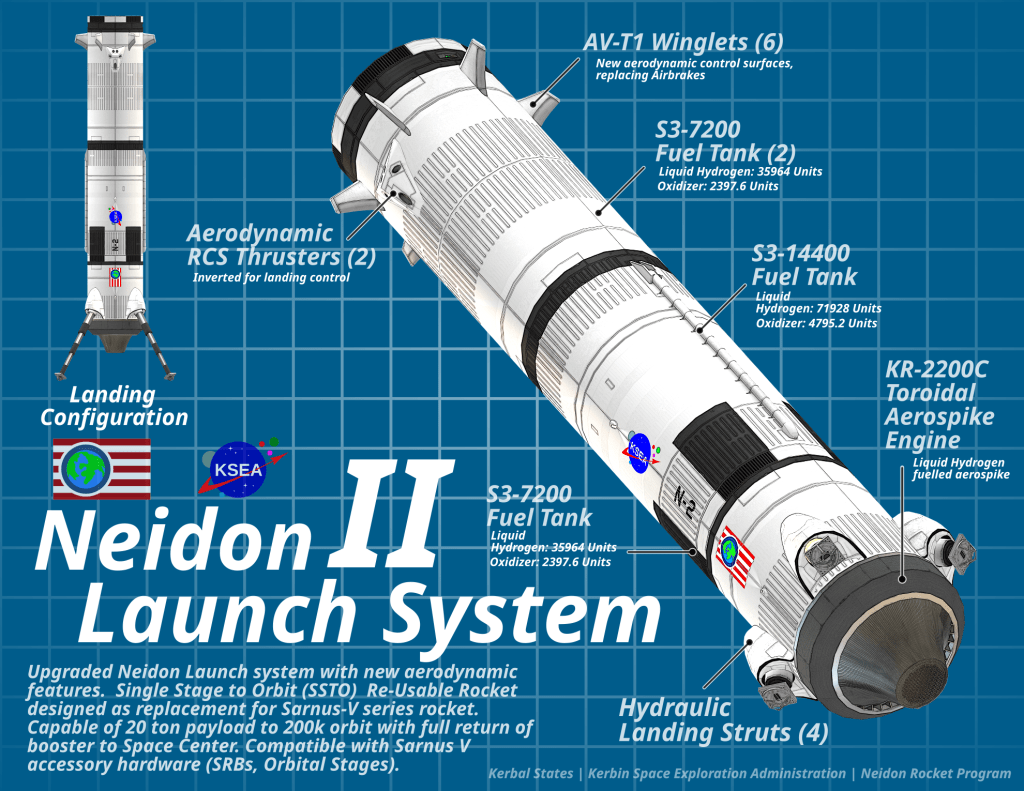
Engineers are excited to announce upgrades for the new Neidon Rocket Launch System – the Neidon II!
While the core rocket booster remains unchanged, several important changes have been made:
Aerodynamic Brakes have been removed
New AV-T1 Winglets have been added to deal with minor instability that occurs during transition from supersonic to subsonic.
Analysis showed that the shape of the RCS boosters at the top of the rocket was better served being flipped, so RCS thruster assemblies were inverted.
Rocket numbering changed from “X” to “N” – in blueprint shown as “N-2” for Neidon Booster 2.
Rockets have been given a fresh coat of paint, with flag and KSEA logos moved.
Besides structural changes, the Neidon Rocket will now have the bottom S3-7200 Fuel Tank prioritized as the “landing tank”. This will move the center of mass for the booster further to the bottom, assisting in re-entry!
“The plan is to test the booster with the upcoming MPV Probe, if everything is good we’ll upgrade the other boosters!” -Gillian, supervising upgrades at the VAB
The Kerbin Space Exploration Administration is excited to announce the next-generation of crew landers: The Variable Inclination New Crew Exploration & Telemetry (VINCENT) Lander!
“Not only does this new lander have more capability than any crew lander we’ve made yet, we designed it to take advantage of the DSV cargo bays! “ -Gene, Speaking at the VAB Lander Research Labs
The Neidon Rocket has entered full production, with 5 total rockets ordered. Two are being refurbished for their next launch, and the other three will be completed within a few months. To help keep track of which rocket is which, they will be labeled X-1 through X-5 !
Neidon is being devolved to be compatible with the existing Sarnus Va expansion options, including upper stage boosts and the THK Solid Fuel Boosters for heavier payloads!
“These rockets are so much easier to recover and refurbish than the Nebula Rockets… we might transition to Neidon Rockets for every Crew Vehicle launch!” -Gene, supervising recovery and refurbishment at the VAB
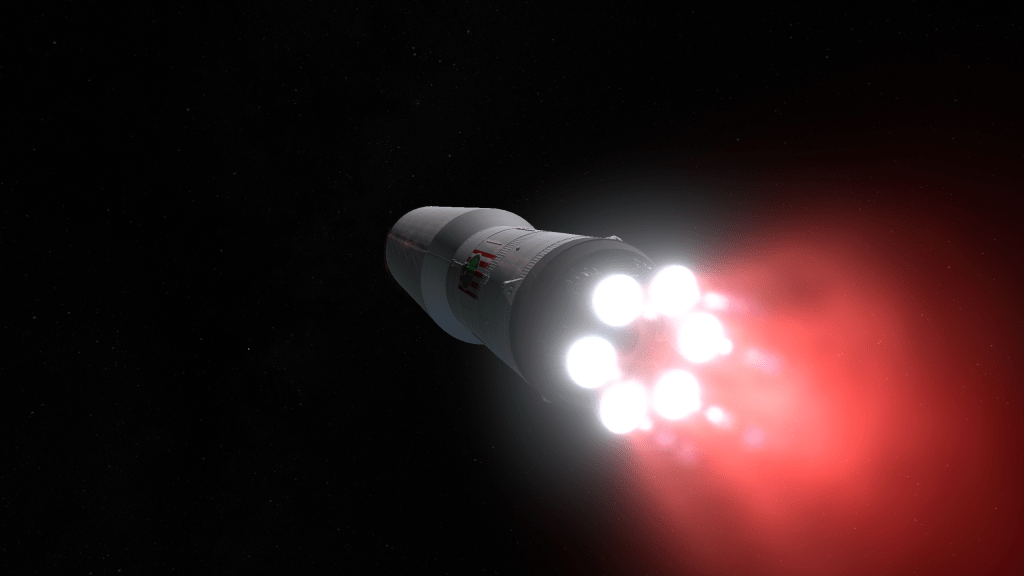
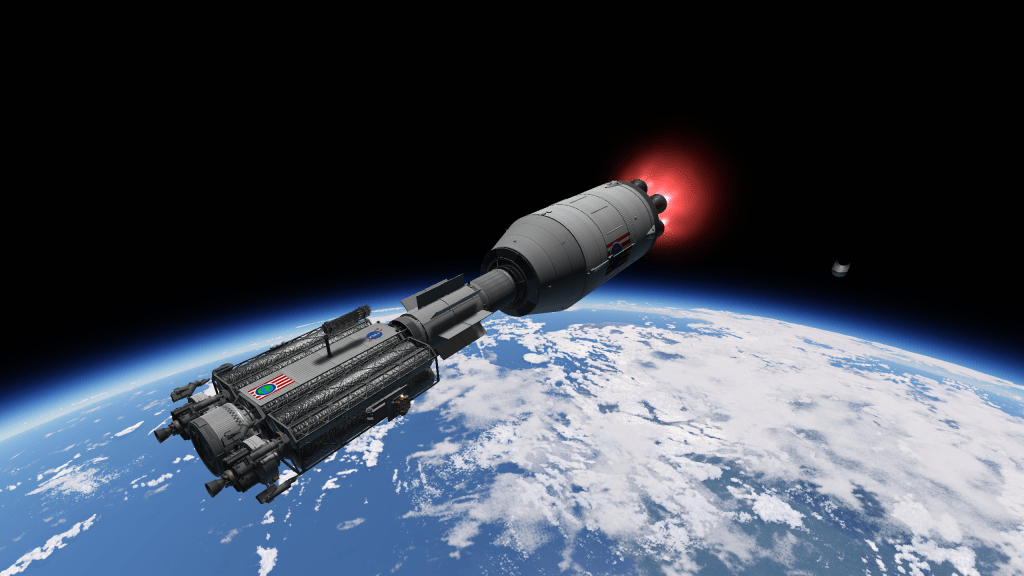
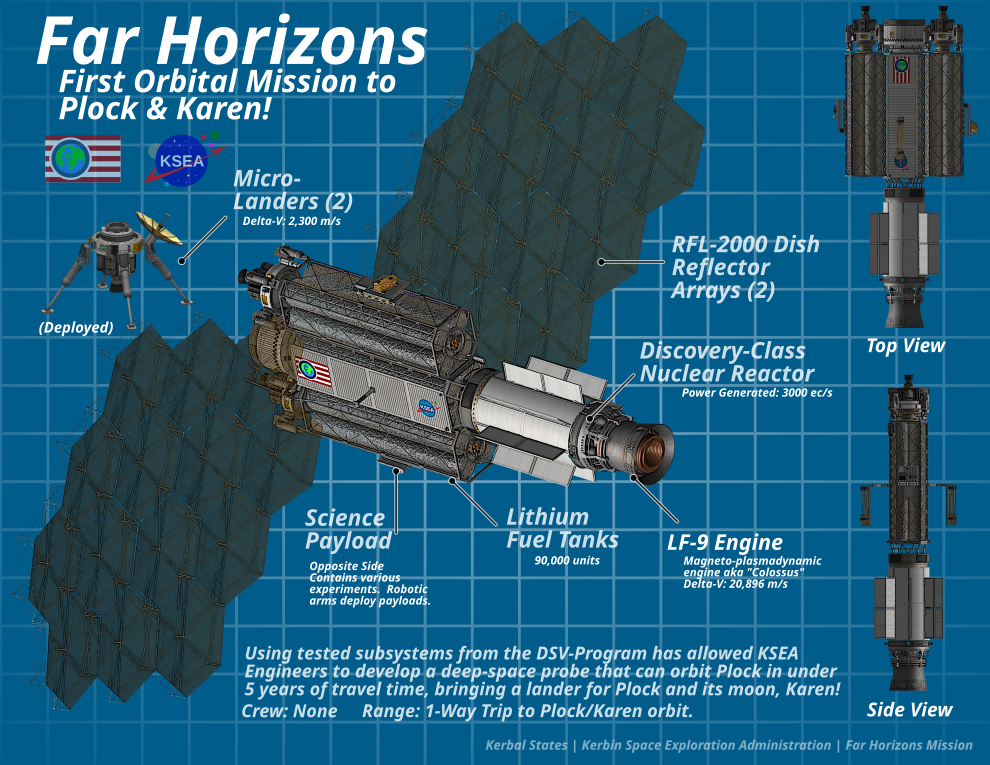
The most far-flung mission ever attempted is ready to launch – the Far Horizons mission to Plock! While there is some debate about whether or not Plock is actually a planet or maybe an asteroid, most Kerbals do agree that it is quite interesting regardless!
The powerful Nova Rocket carries the probe off the launch pad!
“Wow -look at it go!” –Edan, watching from Mission Control
The Nova Rocket’s first stage detaches, falling toward Kerbin…
… while the second stage lifts the probe to a very high orbit of 900k!
The protective fairing ejects right before the orbital circularization manuever begins!
“Looks like a good launch people! Now let’s start systems checks… make sure we’re ready for Plock!” –Gene, at Mission Control
Mission Control will spend the next week testing subsystems and ensuring that Far Horizons is ready for it’s trip! Departure is expected by the end of the year!
KSEA engineers are excited to reveal the refit of the Crew Shuttle Adventure! The entire Crew Shuttle Program was shut down in Year 17 after the CTS-3 Intrepid suffered a major catastrophe – major nose cone damage from re-entry heat that nearly destroyed the spacecraft! Val is widely credited with saving the entire crew with her calm handling of the disaster!
Since then, engineers have been working on a way to make a safer Crew Shuttle – the result is the refit of the only surviving Crew Transport Shuttle – Adventure! (Intrepid was badly damaged, and Endeavor was dismantled!)
The new Crew Transport Shuttle launches using the Nebula Rocket as a re-usable lifter, which should make the entire Crew Shuttle mission reusable! The vehicle is en route to the White Mesa desert launch facility for initial testing.
“If everything works out with Adventure we’ll see about adding a few new space-planes to our roster! We’ll need some new names though – the DSV fleet took ‘Endeavor’ and ‘Intrepid’ for their latest vehicles!”
Blueprints have been released for Sarnus Station, a new deep space research station to be placed in orbit of Sarnus! The station will be launched aboard one of the ultra-heavy Nova Rockets, and carried to Sarnus by a modified DSV class nuclear drive! Once at Sarnus the same nuclear reactor will provide the station with ongoing power. The new Life Support Cargo Modules add a significant amount of mass to the station, however they will hold up to 60 years of life support materials for a crew of 3!
“This is the first step to letting us conduct serious investigation of the Sarnus planetary system! Future expansions will eventually grow the station, and it may even be moved into a different orbit, depending on what we need in future years!” -Gene, at Mission Control
KSEA releases plan for a new Mun Lander! The heaviest Mun Lander yet, the Heavy Mun Lander can transport three Kerbals to the surface and move various payloads, such as Rovers or base components!
This will be the first Mun Lander that won’t be delivered with Aurora Missions – as it’s simply too big! Instead, mission planners intend to provide additional fuel to re-load the Space Port instead!
While scientists are still grumbling that the lack of water means the outpost will likely never be self-sustaining, KSEA is nonetheless excited to release plans for Aurora Base – the next Munar Outpost! The name was chosen to honor the Aurora Program, which paved the way for every crewed KSEA mission!
The site chosen by Orlas and Summer has been named Aurora Crater.
Unlike previous Munar Outposts, this one will have a greenhouse and supplies to make habitability long term, if not permanent (with minor support from Kerbin.)
Construction has already begun, and the Outpost will be launched on a Jool-X rocket soon!