Year 13, Day 129 (Laythe Spaceport Design Announced!)

Designs are (finally!) complete for the Laythe orbital refuelling and science station to be used by Discovery in its upcoming mission! Construction begins on the absolutely massive Jool Ultra-5 Rocket that will take the spaceport to orbit, and then carry it to Laythe.

The Ultra-5 should be a ridiculous sight, basically 5 Jool Rockets strapped together with an equally massive inter-planetary transfer stage at the top. When it launches, it will be the largest rocket ever launched.

Most of our engineers think our DSV type spacecraft are only going to get bigger – I won’t be surprised if this is the first of many of these massive rockets!
-Gene

Year 13, Day 110 (X-10 Laythe Spaceplane Announced!)

KSEA announces the final draft of the X-10 Laythe Spaceplane! In development for longer than the engineers would like to admit, the X-10 is the most sophisticated (and complicated) spaceplane the space program has designed.

The mission that the spaceplane has been designed for is so unique that the KSEA Blueprint Division spent an inordinate amount of time detailing it so that everyone would remember what to do once the spacecraft finally arrived!

Dibs! I can’t wait to land a spaceplane on a moon!”
-Jeb

The pilot program has seen an increase in applicants since the plans were released!

“We finally have a design for a spacecraft that can land on Laythe – we have a way to get crew to Jool and back… now we just need to design a spaceport for the crew to rest and refuel!”
-Bill

Year 12, Day 400 (DSV-2 Discovery Blueprints Released!)

KSEA releases designs for the reusable interplanetary spacecraft Discovery! Discovery is said to have nearly 4 times the range of the Explorer 5-class spacecraft and is designed to orbit Sarnus and return to Kerbin Spaceport!

This will be the second deep space vehicle, the first was the failed DSV-1 Explorer.

Crew Mission 1 (CM1) will be a full systems test consisting of a short flight to Mun and returning to Kerbin Spaceport.

The mission profile for CM2 will be shaped by these results, but KSEA administrators hope Discovery can do what it was designed for: the journey to Sarnus!

Year 9, Day 198 (Pathfinder Probe Details Released)

Pathfinder 1 Deep Space Probe.png

After much clamoring from the Kerbal States public for blueprints of the Pathfinder Deep Space Probes (absent mostly because the Kerbal Blueprint department forgot to release it) blueprints of the Pathfinder Deep Space probe is released!

The probe is somewhat unique as it is really 4 probes in one: a mothership that acts as a relay and orbital scanner and 3 planetary probes, which can be customized for whatever the mission might require, such as aquatic probes, atmospheric probes, or a ground lander.  A future rover is planned, however the size limitation has made functional mini-rovers quite difficult.

Year 9, Day 195 (Aurora Crew Vehicle Upgrades)

AuroraCrewVehicleMk7.png

In addition to development of the X-9 crew vehicle KSEA has also been developing the next generation of Aurora Crew Vehicles, the Mk7!

The Mk7 Aurora Crew Vehicle, or ACV, has been developed to provide a 30 day life support system that can safely reach not only Kerbin orbit but Mun and Minmus as well. The Aurora Command Module has been a critical component in KSEA’s crewed spaceflight program, and this latest development makes little changes to the pod itself.

Instead, advances have been made in fuel storage and design of both the Aurora Rocket and the ACV itself – one striking feature is the Service Bay, which protects Life Support System and the fragile solar panels during launch but opens in space.  The craft also has a newly balanced RCS system that improves docking performance.

The main limitation of the X-9 has been its range – while the craft has a maximum orbit rated at 100k, in reality the craft can only reach an orbit of 80k when the mission profile calls for rendezvous with another spacecraft (which was the main goal of the X-9 program.)

The ACV is a superior spacecraft with only one problem – cost.  The X-9 has trivial costs to refuel and refurbish the vehicle, whereas the ACV costs just under 50,000 each launch.

NOTE:  reaches 178k orbit to rendevous.


Year 9, Day 100 (Explorer 5 Construction!)

Explorer 5 Cryo Crew Vehicle.png

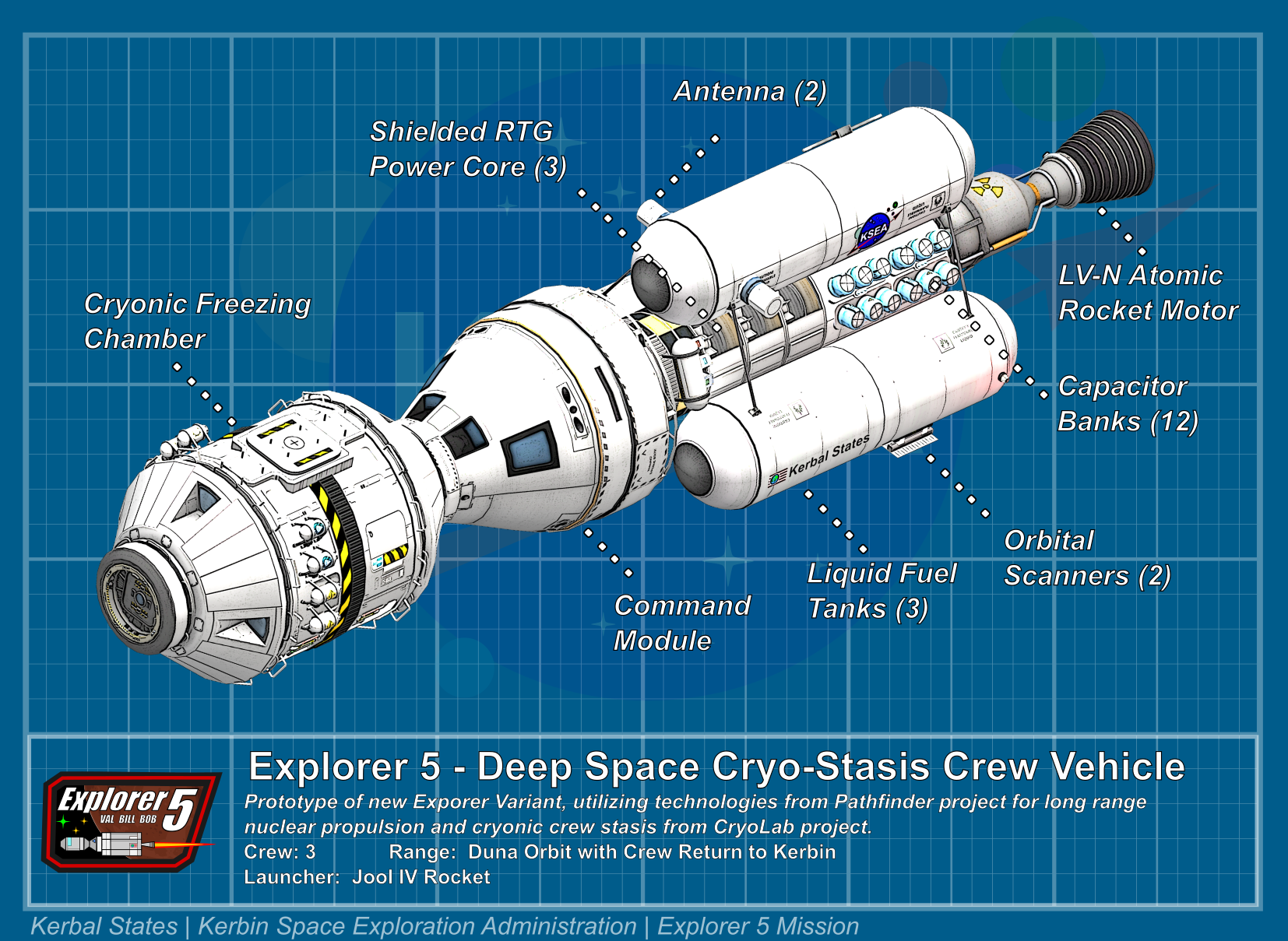
KSEA releases the finalized design for the Explorer 5!  This prototype is hoped to be the future of deep space crewed transportation, making years or even decades long missions pass in as little time as an afternoon nap for the crew!

Val, Bill, and Bob have been training hard for the mission!

This first mission will be to Duna, but if all goes well it will be utilized in a future crewed mission to Jool!


Year 9, Day 25 (Kerbin Spaceport Announced!)

Kerbin Spaceport Blueprint.png

Kerbin Spaceport.pngKSEA announces plans for a new space station in orbit of Kerbin – a Kerbin Spaceport The new station is intended to replace the existing Kerbin Space Station.

Development has only just begun, however the facility is being designed as a jumping off point for missions to deep space, with new and shinier science facilities!

Perhaps most importantly will be the addition of a logistics hub, which will automate fueling missions to the new Spaceport! The core of the new station will be launched on a Jool IV rocket.  Once the budget allows construction will commence at once!


Year 9 , Day 14 (X-9 SSTO Announced!)

X9SSTOCrewShuttle.png

KSEA releases designs for their new aircraft, the X-9 SSTO Crew Vehicle!  The X-9 is the first aircraft to utilize the revolutionary R.A.P.I.E.R. engines, a dual mode engine that uses liquid fuel for atmospheric flight and can switch over to standard rocket fuel once the altitude makes the rocket mode more efficient.

Designed to succeed the current Crew Shuttles, this sleek jet has been designed to reach orbits up to 100k, dock, then return safely to Kerbin.

Production has already begun, and crews will begin testing soon!

Year 7, Day 370 (CryoLab / Crew Cryogenic Research Lab Announced!)

cryolab

KSEA scientists announce they have developed a potential new way to keep Kerbals alive (and fed, and watered, and oxygenated) on very, very deep space missions… freezing them!

On paper it seems to work fine, but before sending Kerbals into deep space and hoping they come out OK it is decided an experimental lab will be launched on the next Heavy Cargo Shuttle launch!

Resolute will carry up the new Cryogenic Study Lab… not surprisingly, several Kerbals have already volunteered for the very dangerous and highly experimental research lab!

Year 7, Day 345 (Kerbol Two Solar Probe Designed)

Kerbol Two Solar Probe.png

A joint effort between KSEA (the Kerbin Space Exploration Administration) and KOAA (the Kerbin Oceanic & Atmospheric Administration) has led to the development of the next solar probe, Kerbol Two!

With greater heat shielding and with the increased range of the massive Jool II rocket combined with the very efficient Atomic Rocket Motor this new solar probe has nearly twice the range of the previous Kerbol One probe!