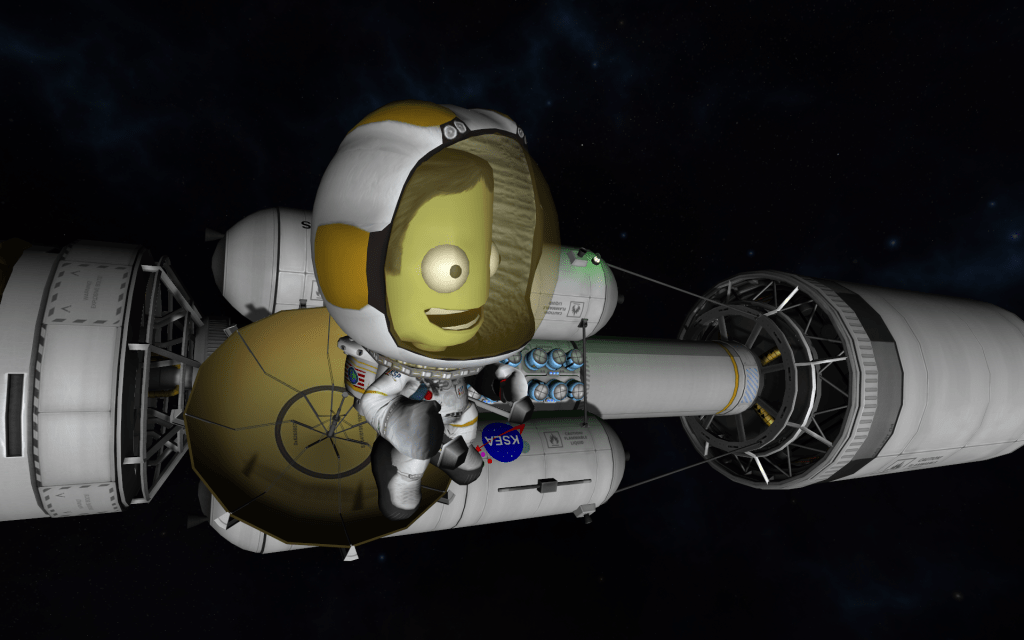
Sean performs an EVA to verify the state of Explorer 6!
Everything looks fine out here! Explorer 6 seems to have held up just fine! The only major system we still need to worry about is the last stage, when we expose the LV-N Nerv engine! -Sean
The mission specialist and chief scientist Glenica is next to head out!
What a view! It’s a shame we can’t stay longer! -Glenica
Glenica’s continues her EVA, collecting various scientific data from Explorer 6’s extensive sensors.
That’s all of it! We should see if we have enough fuel to try transfering to the orbit of some of Jool’s other moons before we leave! -Glenica
Designs are (finally!) complete for the Laythe orbital refuelling and science station to be used by Discovery in its upcoming mission! Construction begins on the absolutelymassive Jool Ultra-5 Rocket that will take the spaceport to orbit, and then carry it to Laythe.
The Ultra-5 should be a ridiculous sight, basically 5 Jool Rockets strapped together with an equally massive inter-planetary transfer stage at the top. When it launches, it will be the largest rocket ever launched.
Most of our engineers think our DSV type spacecraft are only going to get bigger – I won’t be surprised if this is the first of many of these massive rockets! -Gene
The X-10 Laythe Spaceplane is ready for testing on Kerbin (which will start soon.) Meanwhile construction begins on the Jool Rocket that will carry the X-10 into orbit, then to Laythe.
The only missing piece of the Laythe Landing project is the orbiting science station / refuelling depot for the crew once they arrive on Discovery. The Laythe Spaceport’s basic design will be heavily influenced by Duna Spaceport, with the main difference being the fuel type – the Duna Landers all use a standard LFO mix, while the X-10 uses a majority of liquid fuel, with LFO for orbital manuevering only.
There is also an ongoing debate on what to name the X-10 that will be sent to Laythe!
KSEA announces the final draft of the X-10 Laythe Spaceplane! In development for longer than the engineers would like to admit, the X-10 is the most sophisticated (and complicated) spaceplane the space program has designed.
The mission that the spaceplane has been designed for is so unique that the KSEA Blueprint Division spent an inordinate amount of time detailing it so that everyone would remember what to do once the spacecraft finally arrived!
“Dibs! I can’t wait to land a spaceplane on a moon!” -Jeb
The pilot program has seen an increase in applicants since the plans were released!
“We finally have a design for a spacecraft that can land on Laythe – we have a way to get crew to Jool and back… now we just need to design a spaceport for the crew to rest and refuel!” -Bill
With the successful test of Discovery KSEA now has a way to deliver Kerbals to Jool and return them (with their scientific findings!) to Kerbin. The last several weeks have been spent working out the rest of the landing plan. The landing target was an easy choice though….
Laythe! All of Kerbin was fascinated by the amazing photos sent back from Pathfinder 6, so that’s an easy choice! The next important decision is HOW to land.
The Super Duna Lander was the obvious first choice – this lander has been used over and over again by Explorer missions on Duna. Unfortunately the math just doens’t work out. Laythe is just too similair to Kerbin: high gravity, thick atmosphere. The more engineers looked at the problem the more thought a spaceplane might be the right answer. But which?
Despite KSEA’s large selection of spaceplanes, only one is truly a “SSTO” or “single stage to orbit” – the X-9! This plane will be the basis for the X-10 – a spacecraft designed specifically for landing and launching from Laythe! KSEA engineers have already started!
The Laythe Spaceport (also under design) will serve as a fuel and crew hub, with Discovery taking crew back and forth to Jool, and the X-10 operating as the primary lander. The chance to fly a plane on another world has sent applications to KSEA soaring!
KSEA announces a mission to the most distant world known: Plock! Pathfinder will be a slightly modified version of previous Pathfinder probes, instead of the 3-core probe design, one large lander will be used since Plock requires such a great amount of d/v.
Pathfinder 9 will be the second probe to Plock, Pathfinder 6 is already enroute… however there are concerns that Pathfinder 6 won’t have enough d/v to orbit.






 Kerbal States | Kerbin Space Exploration Administration